
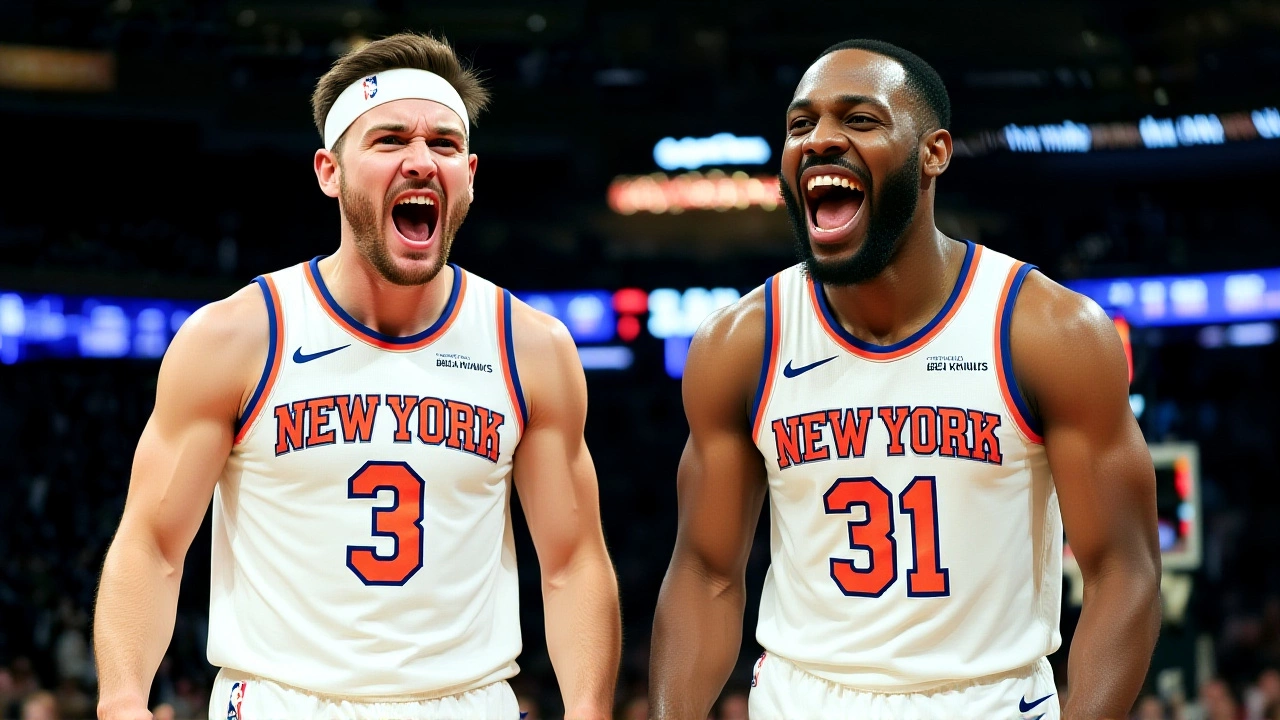
It’s the kind of locker room moment that doesn’t show up in box scores but defines team chemistry. Karl-Anthony Towns, center for the New York Knicks, sat visibly bewildered during a recent postgame media session as his teammate tried to explain basketball strategy using an analogy so dense with statistical jargon it left the All-Star scratching his head.
The exchange happened in the humid air of the Madison Square Garden press area following a game earlier this week in the 2025–2026 season. While reporters were digging for insights on offensive efficiency and shot selection, Josh Hart, the Knicks’ energetic guard, launched into a complex comparison involving advanced metrics. The result? A hilarious pause from Towns that quickly became the viral highlight of the night.
When Analytics Meet Instinct
Here’s the thing about modern NBA culture: everyone talks data, but not everyone speaks the same language. Hart, known for his high-energy play and surprisingly deep engagement with team stats, used an analogy to illustrate a point about decision-making under pressure. He compared a specific defensive rotation scenario to... well, let’s just say it involved layers of conditional probability that would make a math teacher proud.
Towns, who has spent years refining his eye-test instincts since being drafted first overall in 2015, didn’t have a ready translation. "I’m still processing that," he admitted, laughing at his own confusion. It wasn’t a sign of ignorance—Towns is one of the league’s most efficient scorers—but rather a genuine gap between two different ways of processing the game. One player sees the numbers; the other feels the flow.
This isn’t the first time we’ve seen this divide. Remember when Draymond Green tried to explain plus-minus ratings to a rookie in 2018? Or when LeBron James famously shrugged off true shooting percentage debates? The tension between old-school intuition and new-school analytics is a constant thread in the NBA. But seeing it play out in real-time, with two teammates on the same roster, adds a layer of humor that pure analysis can’t capture.
The Players Behind the Laughter
To understand why this moment resonated, you have to look at who these guys are. Towns, born in Edison, New Jersey, and raised with Dominican heritage, brings a smooth, fluid style to the paint. He’s evolved from a traditional big man into a stretch-four powerhouse, averaging over 24 points per game in recent seasons. His game relies heavily on spacing and timing—things you feel, not calculate.
Hart, on the other hand, is the ultimate glue guy. Standing at 6-foot-3, he defies conventional wisdom by leading the league in rebounding among guards multiple times. He’s the type of player who studies film obsessively, looking for edges in every possession. For Hart, the game is a puzzle to be solved with data. For Towns, it’s a rhythm to be mastered.
"Josh loves the numbers," Towns said later, shaking his head with a smile. "He’ll come up with something like ‘if our defensive rating drops below 108 in the second quarter, we need to switch more often.’ I’m just trying to figure out where the ball is going." That contrast is exactly what makes their partnership interesting. They balance each other out—one provides the intellectual framework, the other the physical execution.

Why This Moment Matters Beyond the Joke
But wait—why should we care about a funny press conference clip? Because it highlights a broader shift in how the NBA operates. Teams now employ dedicated analytics departments that track everything from sweat rates to pass trajectories. Players are expected to engage with this data, whether they love it or hate it.
The Knicks, under coach Tom Thibodeau, have always been a bit of an outlier here. Thibodeau is known for his old-school grind-it-out philosophy, yet the organization has quietly integrated advanced metrics into their decision-making process. This creates a unique environment where players like Hart thrive on data while others, like Towns, prefer to keep things simple.
Interestingly, this dynamic isn’t unique to New York. The Boston Celtics and Golden State Warriors also navigate similar tensions. In fact, a study by the MIT Sloan Sports Analytics Conference last year found that teams with mixed approaches to data integration often see better long-term cohesion than those that force uniform adoption of analytics across all players.

Fan Reaction and Viral Impact
Social media exploded, naturally. Clips of Towns’ puzzled face circulated widely on Twitter and TikTok, with fans adding captions like "When your friend explains quantum physics at a party" and "Me trying to understand my bank statement." The humor was universal because everyone has experienced that moment when someone uses a metaphor that just doesn’t land.
Even rival players joined in. Milwaukee Bucks forward Brook Lopez tweeted a GIF of himself looking confused, tagging both Towns and Hart. It’s these human moments that break through the noise of endless stat lines and trade rumors. They remind us that behind the jerseys are people with distinct personalities, quirks, and communication styles.
Turns out, even in a hyper-analyzed sport, some things remain beautifully inexplicable. And maybe that’s the best part of basketball—the unpredictable, unquantifiable spark that happens when great players share the court.
Frequently Asked Questions
What exactly did Josh Hart say to confuse Karl-Anthony Towns?
While the exact wording hasn't been fully transcribed, reports indicate Hart used a complex analogy involving defensive rotations and statistical probabilities to explain a strategic adjustment. He likely referenced concepts like "expected points per possession" or "defensive efficiency ratings" in a way that required immediate mental calculation, which caught Towns off guard during the spontaneous interview setting.
Does this mean Karl-Anthony Towns doesn't understand basketball analytics?
Not at all. Towns is one of the most efficient players in the NBA, consistently ranking high in true shooting percentage and offensive rating. His reaction was more about the complexity of Hart's specific analogy rather than a lack of understanding of basic metrics. Many veteran players prefer intuitive gameplay over real-time statistical breakdowns, especially in casual media settings.
How do the New York Knicks use analytics in their games?
The Knicks employ a hybrid approach. Under coach Tom Thibodeau, they emphasize traditional fundamentals like defense and rebounding, but the front office uses advanced data for lineup optimization and player development. This dual focus allows players like Josh Hart to leverage data while others rely on instinct, creating a balanced team dynamic.
Will this incident affect the relationship between Towns and Hart?
Highly unlikely. Both players have publicly praised each other’s work ethic and versatility. The incident was lighthearted and humorous, reflecting their comfortable rapport. In fact, such candid moments often strengthen team bonds by highlighting individual differences in a fun, non-confrontational way.
When did this postgame interview take place?
The exchange occurred during a postgame media availability in the 2025–2026 NBA season at Madison Square Garden. While the specific date of the game isn't widely cited in initial reports, it took place within the first few months of the regular season, aligning with the team's early-season push for playoff positioning.